
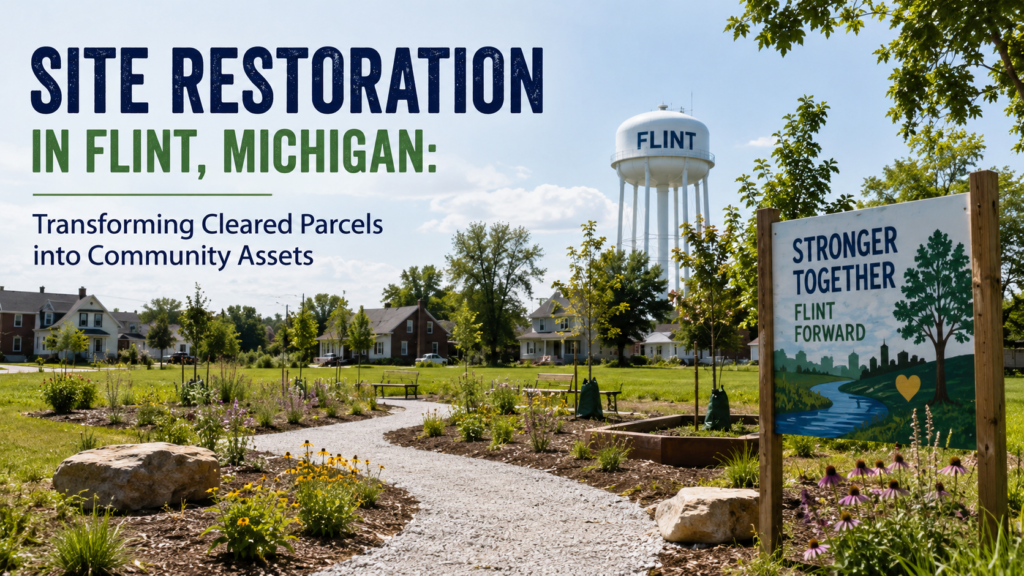
In Flint, Michigan, site restoration is more than a construction service. It is a critical step in the city recovery and revitalization story. When a blighted building is torn down, when a contaminated industrial parcel is cleared, or when a vacant lot that has been neglected for years is finally brought back into productive condition, site restoration is the process that transforms an eyesore, a hazard, and a neighborhood liability into a stable, safe, and potentially productive piece of land. Understanding what Site Restoration Flint involves in Flint specific context, including the legacy of industrial use, the scale of blight elimination, the importance of environmental remediation, and the community development goals that guide land use decisions, gives property owners, community organizations, and developers a complete picture of this essential service.
What Site Restoration Encompasses
Site restoration is the process of bringing a disturbed, contaminated, or degraded parcel of land back to a condition that is stable, safe, and capable of supporting its intended next use. In the context of Flint land clearing and demolition activity, site restoration typically includes some combination of:
- Foundation and debris removal. Excavating and removing remnant concrete foundations, buried demolition debris, old septic systems, underground storage tanks, and any other sub-surface materials that would prevent proper grading or create ongoing problems if left in place.
- Contaminated soil assessment and remediation. Testing and addressing soil contamination from past uses, including petroleum products, heavy metals, and chemical compounds from Flint industrial and commercial history.
- Grading and drainage establishment. Reshaping terrain to create positive drainage away from neighboring properties and toward appropriate stormwater management features, preventing standing water and ongoing erosion.
- Topsoil placement. Where the site will support vegetation, quality topsoil provides the growing medium for plant establishment.
- Erosion control and vegetation establishment. Seeding, sodding, erosion blankets, or other measures that stabilize soil and prevent wind and rain erosion on the restored site.
- Invasive species management. Many long-vacant Flint parcels are colonized by invasive plant species that require specific management approaches beyond standard clearing to prevent re-establishment.
The Brownfield Context in Flint
Flint industrial history, dominated by General Motors manufacturing operations that made the city a center of American automotive production through much of the twentieth century, left behind significant brownfield inventory. The Genesee County Land Bank Authority has worked extensively with the EPA and the Michigan Department of Environment, Great Lakes, and Energy (EGLE) to assess and remediate brownfield sites throughout Flint. EPA Multipurpose grants have funded cleanup activities on residential and commercial sites in Flint Innovation District and other revitalization areas. EGLE Part 201 environmental cleanup program allows contaminated properties to be cleaned to standards appropriate for their intended future use, enabling contaminated parcels to move toward productive reuse efficiently.
Post-Demolition Restoration Process
The most common form of site restoration in Flint today follows the demolition of blighted residential structures under the Genesee County Land Bank blight elimination program. After a blighted house is demolished and debris removed, the standard restoration sequence includes foundation removal or fill to eliminate the underground concrete as a future obstruction, site grading to establish appropriate drainage typically a gentle slope toward the street or an adjacent drainage feature, and topsoil and vegetation establishment. The Land Bank plants Dutch White Clover seed after residential demolitions because it germinates quickly providing rapid erosion control, fixes nitrogen in the soil improving soil quality over time, provides pollinator habitat, and reduces long-term mowing and maintenance costs. This restoration approach leaves former blight sites as stable, green parcels that contribute positively to neighborhood character.
Soil Quality and Lead Contamination
Given Flint industrial history and the prevalence of older residential areas where lead paint was widespread, soil testing has become a standard element of many site restoration projects. Lead in residential soils from deteriorated exterior lead paint is a recognized issue throughout older urban areas. Sites where children will have regular contact with soil including residential lots converted to community gardens or play areas should be tested for lead and other contaminants before such uses are established. EGLE and EPA provide guidance on acceptable lead levels in soils under different land use scenarios, with remediation options including removal and replacement of contaminated soil, capping with clean fill, or installation of hard surface barriers available for sites exceeding applicable standards.
Community Garden and Green Space Transformation
Many of Flint restored vacant parcels have found productive community uses as community gardens, urban farms, pocket parks, and neighborhood green spaces. These uses have flourished in part because the city blight elimination programs have created a supply of cleared, accessible lots, and in part because community organizations have invested in additional restoration work including raised beds with imported clean soil, fencing, water access, and community programming needed to transform a cleared lot into functional food production or recreation space. The Genesee County Land Bank lot transfer programs allow community organizations and individuals to acquire cleared Land Bank parcels for community use at accessible transfer prices, and site restoration that prepares these parcels appropriately has become a meaningful strand of Flint food access and community health strategy.
Conclusion
Site restoration in Flint is an essential bridge between the city past and its future as a revitalized urban community. Whether following the demolition of a blighted residential structure, the cleanup of a contaminated brownfield, or the preparation of a vacant parcel for community garden or new construction use, site restoration transforms land from a liability into an asset. Understanding the full scope of what restoration involves from foundation removal and contamination assessment through grading, soil quality management, and vegetation establishment positions everyone involved in Flint revitalization to approach these projects with the knowledge that produces lasting, beneficial results.